Why Finding Yourself Won't Help You Change Careers

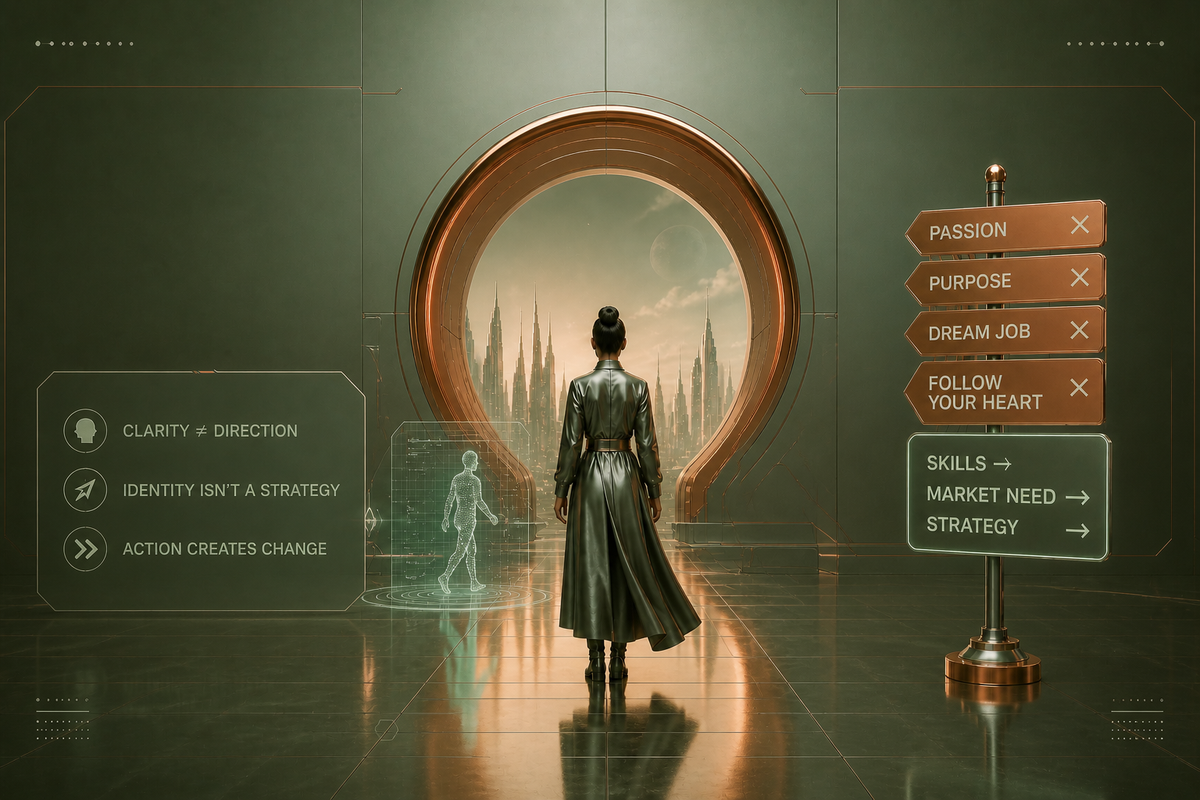
You know your four-letter type and your top five strengths. You may have got there through a coach, or on your own at midnight with a coffee you should not be drinking and a browser tab you will not admit to anyone. Either way, you have a file somewhere, mental or actual, full of words that describe you accurately and have not helped you decide anything.
Self-discovery was the wrong starting point. The sequence sounds right: understand yourself, then match that understanding to a career that fits. Every career change book, course and coaching programme you have encountered gives you some version of it. The instinct to know yourself before making a major decision is reasonable. It also does not work.
The assessment spiral
You received a profile after your last assessment. It told you real things. You are high in openness, you value autonomy more than security, you are an integrator. Fine. All of this is probably accurate.
Now try to use it. You have five career options on your list. Which ones does "high openness" eliminate? Which ones does "values autonomy" rule out? The assessment described you correctly but left the decision exactly where it was. You have more vocabulary for your situation and the same number of options.
Each new test adds a real insight and zero traction. Traits like the Big Five correlate with job performance in measurable ways, but their link to career satisfaction is weak and inconsistent across studies. What the tests measure does not determine which career will make your weeks feel like yours. You already have enough results. The answer you are waiting for is one that personality assessments were never designed to deliver.
The self you are looking for keeps changing
The "find yourself first" approach rests on an assumption: that your identity is a stable, discoverable thing, and that the job of self-discovery is to uncover what is already there.
A study published in Science by Daniel Gilbert and colleagues tested this across more than 19,000 people aged 18 to 68. They found something consistent at every age. People believed they had changed enormously in the past ten years. They also believed they would change very little in the next ten. Gilbert called it the "end of history illusion." At every point in your life, you tend to believe you are the finished version of yourself.
Your values shift. Your preferences reorganise around experiences you have not had yet. The personality you would be discovering today will already be out of date by the time you finish the matching. You are trying to hit a target that moves every time you look away from it. That is the structural problem with the entire approach, and the search never ends because the thing you are searching for keeps changing under your feet.
Herminia Ibarra's research on professionals in career transition confirms this in practice. The people who successfully changed careers tried on what Ibarra calls "possible selves," and their sense of identity shifted through the process of doing. Knowing is the result of action and experimentation. You come to know yourself more clearly through the choices you make.
The waiting is the problem. The understanding you expect from more reflection is produced by the process you have been postponing.
The Exploration Trap
The list keeps growing.
You've been researching career options for months. Each round of research adds another possibility and closes none. There's a name for that pattern. This free 5-page guide explains why it happens and what shrinks the list.
Free PDF. Yours in under a minute.
What you can already rule out
You have been asking "who am I, really?" as though answering it would unlock the decision. The question is too large and too abstract to resolve at a desk. You find out who you are by what you do, what you choose, what you eliminate. The knowledge comes after.
What can you already rule out?
You know more than you think. You know which of your options requires relocating, and that you are not going to relocate. You know which one pays well but requires the exact working conditions you are trying to leave. You know which one you keep on the list because someone you respect suggested it three years ago and you have never had the conviction to cross it off.
These are answered questions you have not acted on yet. Each one you remove makes the remaining decision simpler. Two options are easier to evaluate than five. The evaluation requires you to use what you already know, and you already know enough.
Start there. Admit which options are already dead.
The trap
The "find yourself" path is comfortable because it feels like progress without requiring a decision. Every assessment produces a new insight, a sharper vocabulary. The pile of self-knowledge grows. The list of career options stays the same length. It is productive without being useful, and it can continue indefinitely, because discovering more about yourself is more exciting than deciding.
The decision is where the understanding starts.